

Legal intake is where most law firms lose revenue. Cases don't fail at trial — they fail before the firm ever signs the client. Missed calls on nights and weekends. Spanish-speaking callers who hang up because nobody answers in their language. Intake staff who give up on qualification halfway through because they're overwhelmed.
For firms in Texas — where Spanish-speaking clients are a huge portion of the market — the problem is more acute. Bilingual intake capacity is scarce, expensive, and burns out fast.
This is how a bilingual AI voice agent changes the math. Specific examples from our live deployment at Hector Peña Law.
The real cost of missed and mishandled calls
Run the numbers for a typical personal injury firm in DFW:
- Average case value: $15,000–$50,000 (low-end settlements); $100,000+ for serious injuries
- Average intake conversion rate: 30–50% of qualified calls become signed clients
- Calls missed or mishandled per month (industry average): 15–25%
Even at the low end — a firm missing 15% of calls, where the average case is $15K, at 40% conversion — that's $22,500 of lost case value per month from call handling alone. Over a year, that's $270,000.
That number ignores the Spanish-speaking calls the firm can't handle at all. In DFW, that's often another 20–30% of total call volume.
What a bilingual AI voice agent actually does
An AI voice agent is a phone system that:
- Answers every incoming call 24/7 in a natural-sounding voice
- Detects the caller's language (English or Spanish) within the first few words
- Conducts a multi-step intake conversation in the caller's preferred language
- Qualifies the case based on firm-specific criteria (case type, incident date, injuries, prior representation, etc.)
- Books qualified prospects directly onto an attorney's calendar
- Transfers urgent or high-value calls directly to a live attorney when configured
- Logs everything — transcript, audio recording, caller info — into the firm's CRM
It's not a chatbot. It's a real voice call, indistinguishable from a human receptionist in most cases, working 24/7 in two languages.
The Hector Peña Law deployment
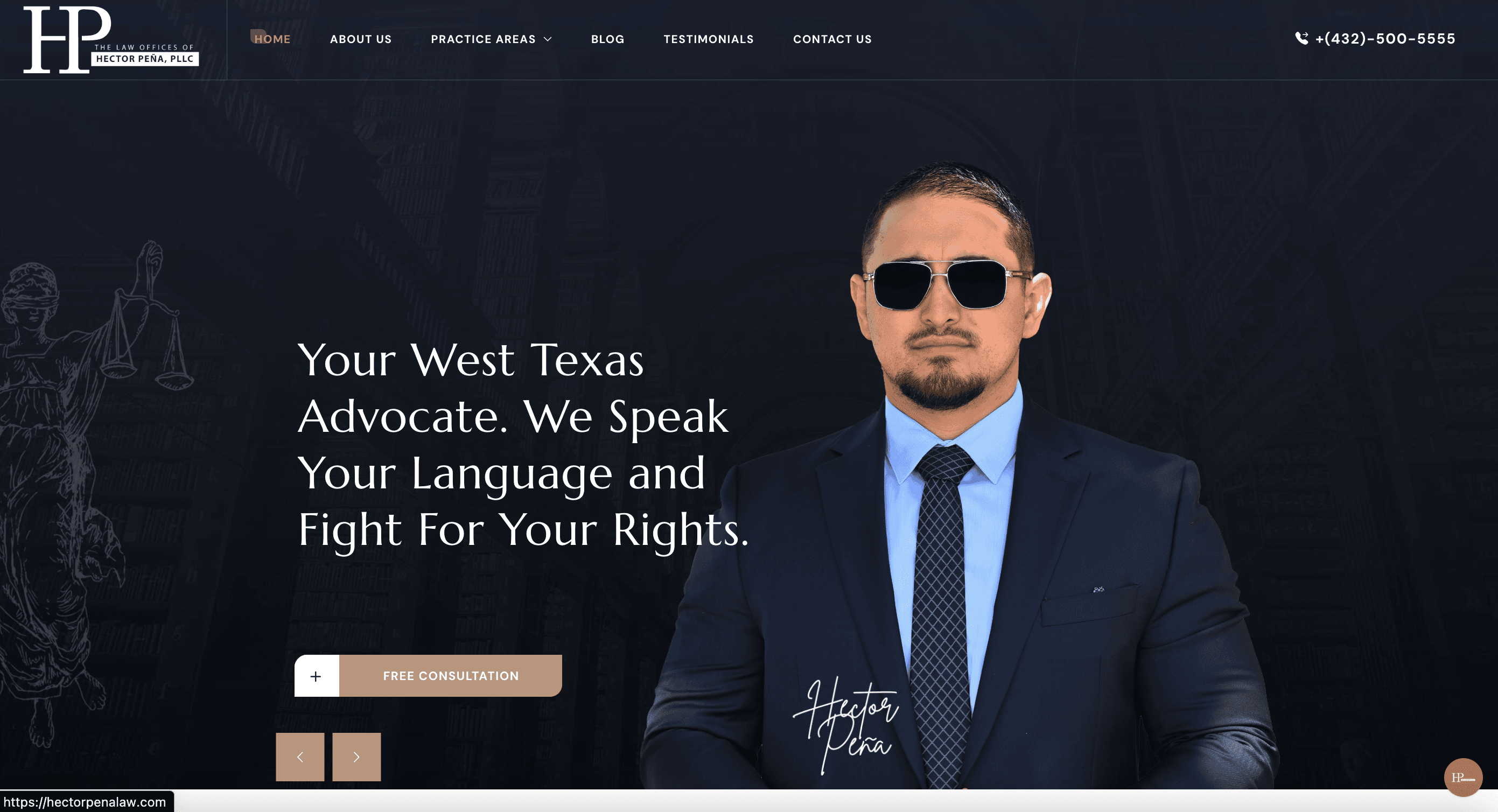
Hector Peña Law serves clients across West Texas in personal injury and criminal defense. Before we built their intake system, the firm depended on referrals, paid ads, and a traditional receptionist during business hours. After hours and weekends, calls went to voicemail.
What we deployed:
- Full bilingual AI voice agent trained on the firm's intake protocols
- Custom qualification flow covering case types (auto accidents, 18-wheeler, oilfield injuries, criminal defense)
- Integration with the firm's GoHighLevel CRM
- Automated English/Spanish email and SMS follow-ups based on intake outcome
- Live transfer to on-call attorneys for urgent cases
What changed:
- 500% increase in qualified leads within 3 months
- $500K+ in projected case value pipeline
- ROI recovered by month 2
- Cost per qualified lead dropped to approximately $127 (vs industry averages of $400–$800)
The firm now captures every inbound call — including the 2 AM DUI arrests and the Saturday afternoon auto accidents. Nothing goes to voicemail. The language barrier is gone.
Why bilingual matters so much in Texas
Spanish-speaking clients represent 20–35% of the personal injury market in DFW, Houston, and especially South Texas / the Rio Grande Valley. Firms that can't handle Spanish intake lose that entire segment to firms that can.
The traditional solution is hiring bilingual intake staff. The problem:
- Bilingual intake specialists cost $45K–$65K/year in DFW
- Good ones are hard to find and quick to leave
- Even a full-time bilingual staff member can't cover 24/7
- Turnover means retraining every 12–18 months
An AI voice agent handles Spanish calls 24/7/365 for roughly the cost of a month of a bilingual staffer's salary. It doesn't call out sick. It doesn't get burned out. It handles 50 calls simultaneously if needed.
This isn't an argument for replacing your staff. It's an argument for coverage: your humans handle the cases that need real attorneys; the AI handles everything else.
What to look for in a legal AI voice agent
Not every AI voice agent is built for legal intake. Things that matter:
1. Case-type specific qualification
Generic "lead qualification" doesn't work for legal. A car accident case needs different questions than a criminal defense case, which needs different questions than a slip-and-fall. The agent needs to detect case type early and branch the flow accordingly.
2. Statute of limitations handling
For personal injury, the first question after case type is usually "when did this happen?" Texas has a 2-year SOL on most personal injury. The agent should flag cases near or outside SOL and route them appropriately.
3. Conflict checking integration
Before scheduling, the agent should check against the firm's existing client database for conflicts. This is a dealbreaker feature that a lot of lightweight systems skip.
4. HIPAA-aware configuration
For firms handling medical malpractice or any case with medical records, HIPAA-compliant call handling matters. The agent's data flows need to be encrypted, auditable, and compliant.
5. Live transfer capability
For urgent or high-value calls, the agent needs to transfer to a live attorney — not a receptionist, not a voicemail. An AI agent without live transfer is insufficient for serious legal intake.
6. CRM integration
Every call transcript, audio recording, and intake outcome should flow directly into your case management system. Without this, the agent is a front-end with no useful back-end.
We build all of these into our AI Voice Caller deployments for law firms. We scope and quote each build to the firm's case types and call volume, with the bilingual configuration available as part of the Pro tier.
What it takes to deploy one
Rough timeline:
Week 1: Discovery. We map the firm's existing intake flow, case types, attorney specialties, and current pain points. Identify where calls are failing today.
Week 2: Script and flow design. Build the qualification tree. Define transfer rules. Design fallback handling for edge cases.
Week 3: Build and voice training. Deploy the agent. Train on the firm's specific case types, language, and tone. Test hundreds of scenarios.
Week 4: Live testing. Attorneys and staff stress-test the agent with real-world calls. Tune until it feels right.
Week 5: Go-live. Agent deploys. Monitoring kicks in. Daily review of transcripts for the first 2 weeks; weekly after that.
Total: 4–6 weeks from kickoff to live. Longer for larger firms with more case types.
Common concerns and honest answers
"What if a caller wants a human?" The agent transfers immediately on request. Transparency: most firms have the agent introduce itself as an AI assistant. Counterintuitively, this actually builds trust.
"What if the agent makes a mistake?" Every call is transcribed and reviewed. We tune weekly based on actual call data. Mistakes happen but they're logged, learned from, and patched.
"What about calls that need real legal judgment?" Those transfer to a live attorney. The agent is for intake and qualification, not legal advice. The rules are built in.
"Is this HIPAA compliant?" Yes, when configured that way. We deploy HIPAA-compliant configurations for firms handling sensitive medical cases.
"What about the firm's brand voice?" The agent's voice and tone are customizable. It can sound professional and warm, formal and efficient, or whatever matches the firm's positioning.
The ROI math for a typical firm
Scenario: A 3-attorney personal injury firm in DFW with 80 incoming calls/month.
Current state (without AI voice agent):
- ~12 calls missed or mishandled per month (15%)
- At ~40% qualified, ~40% signed: 2 lost cases per month
- At $15K average case: $30,000/month in lost revenue
- Annual: $360,000
After AI voice agent:
- 0 missed calls, 24/7 intake
- Setup + monthly: a first-year investment in the low five figures
- Case recovery: $30K+/month conservatively
Payback period: under 30 days. After that, the agent is essentially printing money for the firm.
This math is why we see law firms consistently come back for expanded AI voice deployments after the first one proves out.
Running a law firm in Texas? Spanish intake leaking revenue? Book a free consultation — we'll walk through your current call flow and show you what an AI voice agent would look like for your specific practice. Or see the full AI Voice Callers service.